
Morton’s Neuroma
Morton's Neuroma Clinic

By Neurosurgery Singapore
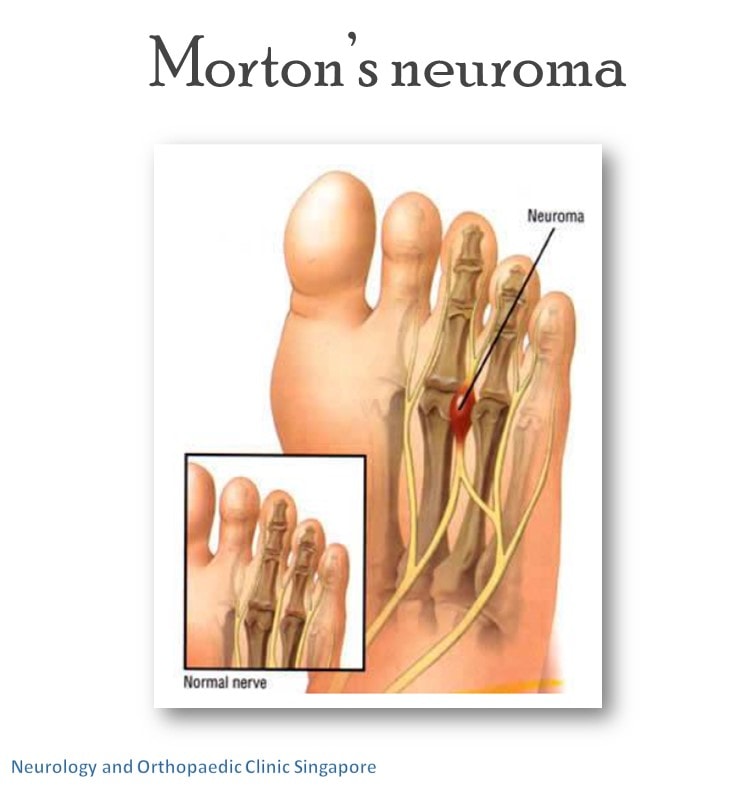
What is Morton’s neuroma?
A neuroma is a thickening of nerve tissue that may develop in various parts of the body. The most common neuroma in the foot is a Morton’s neuroma, which occurs between the third and fourth toes. It is sometimes referred to as an intermetatarsal neuroma. Intermetatarsal describes its location in the ball of the foot between the metatarsal bones. Neuromas may also occur in other locations in the foot.
In Morton’s neuroma, the nerve becomes thickened due to ongoing compression and irritation. This pressure causes the nerve to swell, leading to pain and other symptoms, and over time it can result in permanent nerve damage if not treated.
Women are more likely than men to get Morton’s neuroma.
What are some underlying symptoms of Morton’s neuroma?
Morton’s neuroma doesn’t usually cause any visible signs like a lump, so diagnosis is based on what you feel. The first symptom is often a tingling or burning sensation between your toes. Thereafter you may feel the following:
- The tingling may get stronger as time goes on.
- You may feel shooting pains around the ball or your foot or the base of your toes.
- Your foot may feel like there’s a pebble in your shoe or a sock is bunched up. Your toes might burn or feel numb.
- The discomfort may get worse when you’re walking or wearing shoes that squeeze your feet.
- The pain tends to ease off at night.
What are possible causes of Morton’s neuroma?
Morton’s neuroma is often caused by wearing tight shoes or high heels, which put pressure on the nerves in your feet. This pressure can irritate the nerve, causing it to thicken and become increasingly painful over time.
Another possible cause is a foot or gait abnormality, which can lead to instability and can also put pressure on a nerve in your foot.
Morton’s neuroma is often associated with:
- flat feet
- high arches
- bunions
- hammer toes
It’s also associated with activities such as:
- repetitive sports activities, such as running or racquet sports, that increase pressure on the ball of the foot
- sports that require tight shoes, such as skiing or ballet
Sometimes, a neuroma results from injury to the foot.
“For most people, shots, exercises, or changes in footwear are enough to ease or stop symptoms. But if you’ve tried all these things and still don’t get relief, your doctor might suggest surgery. Of the people who have it for this condition, it helps about 75%-85% of the time.”
We have a solution to stop the pain. Click here to let us help you.
What types of diagnosis?
Our Neurosurgeon will talk with you about your general health and medical history, and ask questions about the location, nature, severity, and duration of your symptoms. It is important to also discuss specific activities you have noticed that bring on the pain, as well as things that provide relief (e.g., rest, changing shoes).
Our doctor will perform a physical exam, including:
- Evaluating the skin of the foot and ankle for signs of excessive pressure points (areas that are painful to the touch).
- Checking the position of the toes and foot for common deformities that may also cause pain in the forefoot.
- Putting pressure on the spaces between the toes to try to pinpoint the specific site of the pain.
- Assessing range of motion of the toe joints, as well as other joints, to see if there is irritation that may suggest arthritis or joint inflammation as a cause of the pain.
- Possibly squeezing your foot to check for a click between your toes — called a “Mulder’s click” — that is sometimes present with a Morton’s neuroma.
X-rays may be required to rule out a stress fracture or arthritis of the joints that join the toes to the foot. Advanced imaging, such as an MRI, may be necessary in certain cases, but this is often not needed.


Possible treatment methods?
Conservative treatment starts with using arch supports or foot pads for your shoes. These help relieve the pressure on the affected nerve. They can be over-the-counter (OTC) inserts or custom made by prescription to fit your foot. Our doctor may also suggest OTC pain killers or nonsteroidal anti-inflammatory drugs.
Other conservative treatments include:
- physical therapy
- stretching exercises to loosen tendons and ligaments
- massaging the ball of your foot
- exercises to strengthen your ankles and toes
- resting your foot
- applying ice to sore areas
A Morton’s neuroma surgery involves excising (cutting out) the nerve. This is performed through an incision over the back of the forefoot, between the corresponding metatarsal heads (knuckles).
Surgery for Morton’s neuroma is often very successful, but it’s usually considered only after non-surgical treatments have been tried. Many people get relief from steroid injections and other conservative options. Surgery may be recommended if your pain is severe or if other treatments haven’t helped.
This surgery does not take long. It is usually carried out under local anaesthetic, on an outpatient basis, which means you won’t need to stay in hospital overnight. The operation can take up to 30 minutes.
Contact us to understand more.
